Tailored documents
Evidence briefs, target dossiers and literature maps built around your question, with every figure linked to its source record.
Neuro Atlas · for clinicians and research teams
Five analytical tools for trial scouting, literature discovery, target diligence, brain-disorder evidence and receptor pharmacology. Each states its inputs, outputs, data sources and how it was measured, caveat included. If it's useful for your work, tell us what you need.
No commitment; we reply with what we can do and what it would cost.
Neuro Atlas 3D, recorded in the tool on the open-licence brain: white-matter tracts, then a disorder's structures lit in rank order.
Counted by the store's build script from each tool's own data files on 24 Nov 2026.
Each tool with its inputs, outputs, data sources and its measured result on held-out data, caveat included.
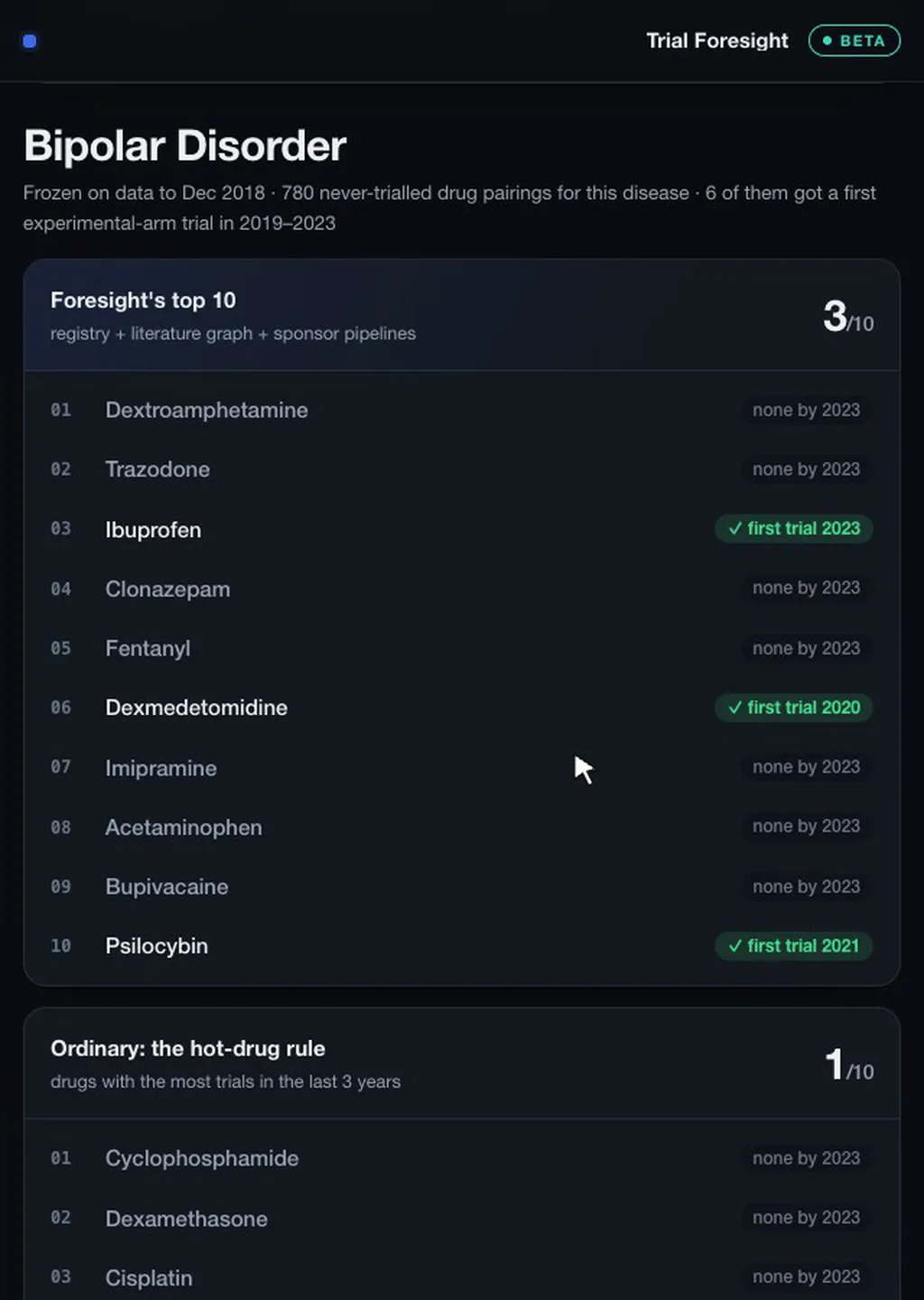 Trial ForesightWhich existing drugs are most likely to get their first trial for a disease next.Forecast + back-test
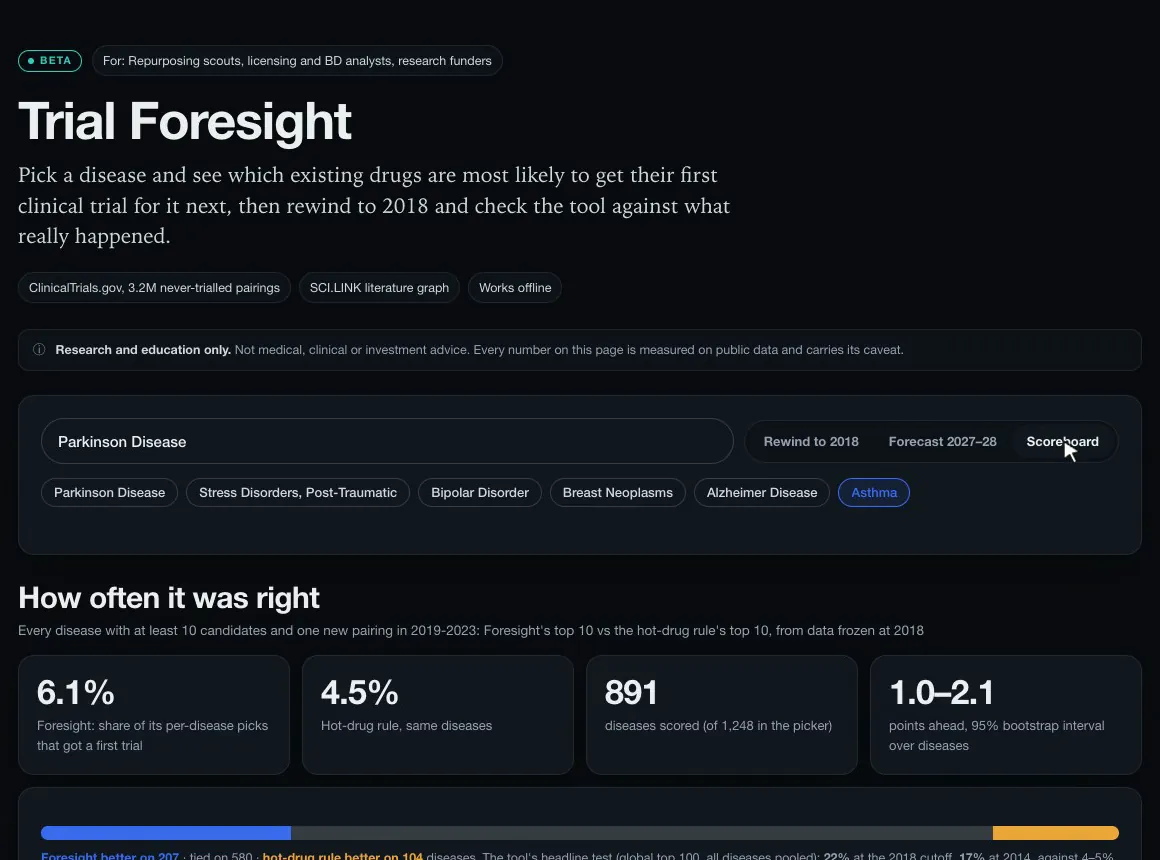
Pick a disease and get never-trialled drugs ranked by calibrated chance of a first registered trial. Rewind to 2018 to see the method's picks beside what actually happened in 2019–2023, and the simple 'hot drug' rule's picks beside them.
It forecasts trial registration, not whether a drug works. Many top picks are established drugs used as procedure or combination partners (anaesthetics, analgesics, statins), and its scores run about twice too high at the very top.
MethodFrozen at end-2018, scored on first trials naming the drug in an experimental arm in 2019–2023 (ClinicalTrials.gov); 95% CI 14–32%; replicated at the 2014 cutoff (17%); Holm-corrected against the hot-drug rule.
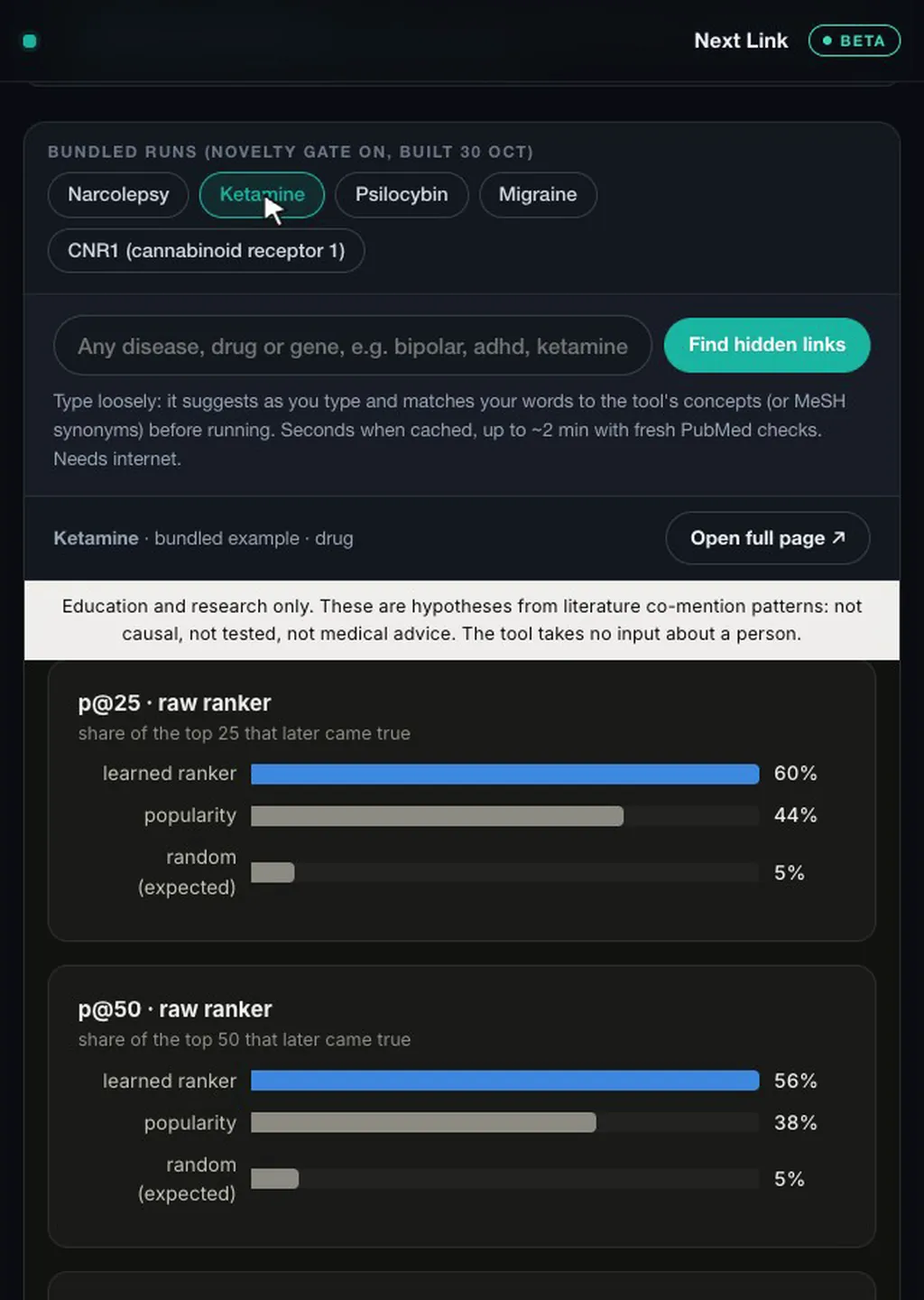 Next LinkConnections the literature keeps circling but has never studied together.Hidden-link miner
Type a disease, drug or gene and get concepts that share many bridges with it in the literature but have (almost) never been studied with it, each with its PubMed count, the bridging concepts, verified papers and whether a trial is registered. A novelty gate removes links PubMed already has under other words.
These are co-mention patterns, not causal or tested claims. On strictly open pairs (≤3 papers) it only ties popularity at the 2019 split; its edge is mostly in ordering thinly studied links.
MethodFrozen at 2015 on 60 pre-registered held-out terms; a hit is a first co-mention in 2016–2026; behind the ≤20-paper novelty gate. Replicated at 2019: 9.2% vs 5.7% vs 0.3%.
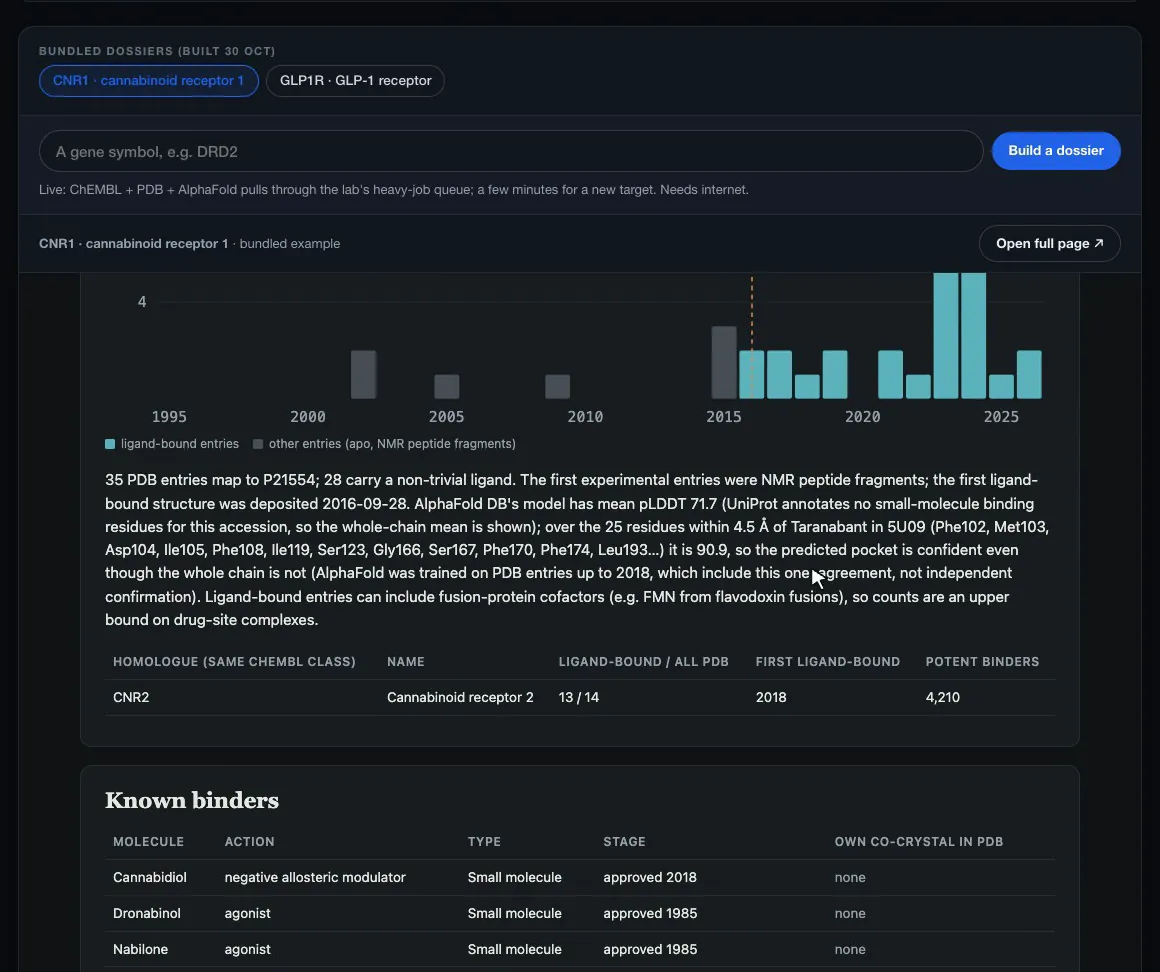
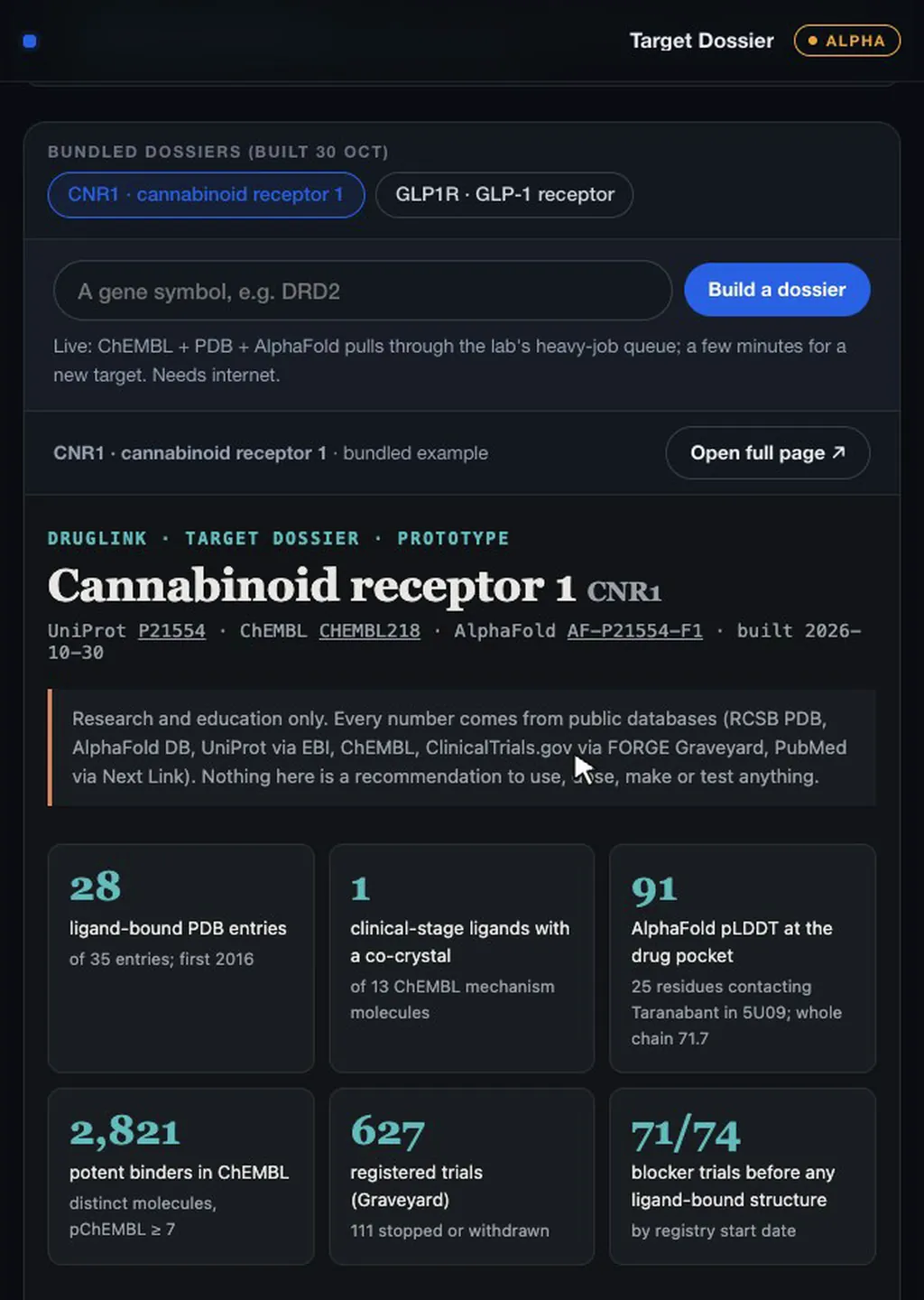 Target DossierThe one-page dossier a diligence team builds by hand, for one drug target.One-page target file · early version
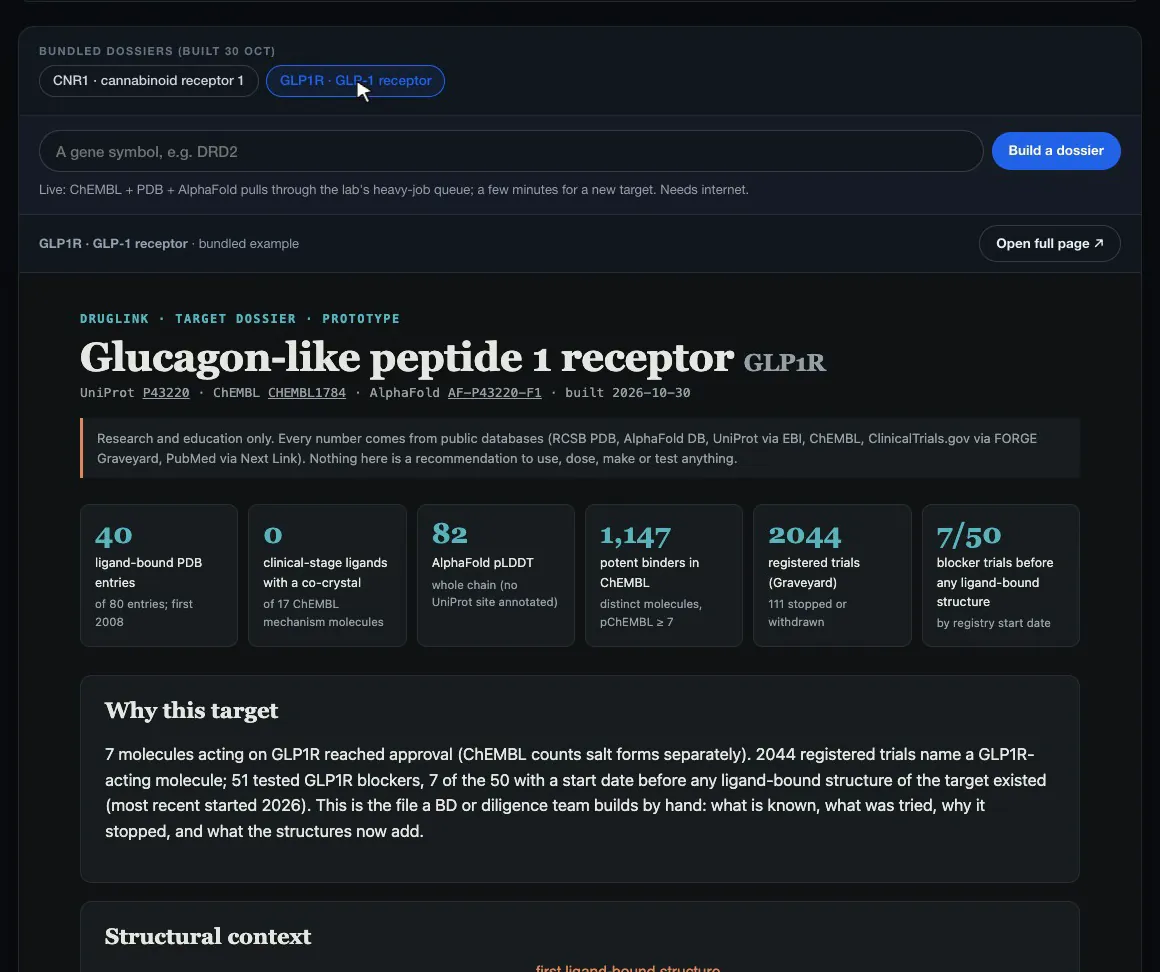
Structures, every measured binder, the drugs on the target and how their trials ended, joined on the target's IDs. CNR1 shows a structure that arrived only in 2016 and rimonabant's withdrawal; GLP1R shows the opposite shape.
A context page, not a verdict: on held-out data the structural evidence did not improve DRUGLINK's ranking, and Foresight's edges on it are provisional. Research only; no dosing, synthesis or testing content.
MethodEvery figure on the page re-derives from cached public pulls, joined on UniProt, ChEMBL and PDB identifiers.
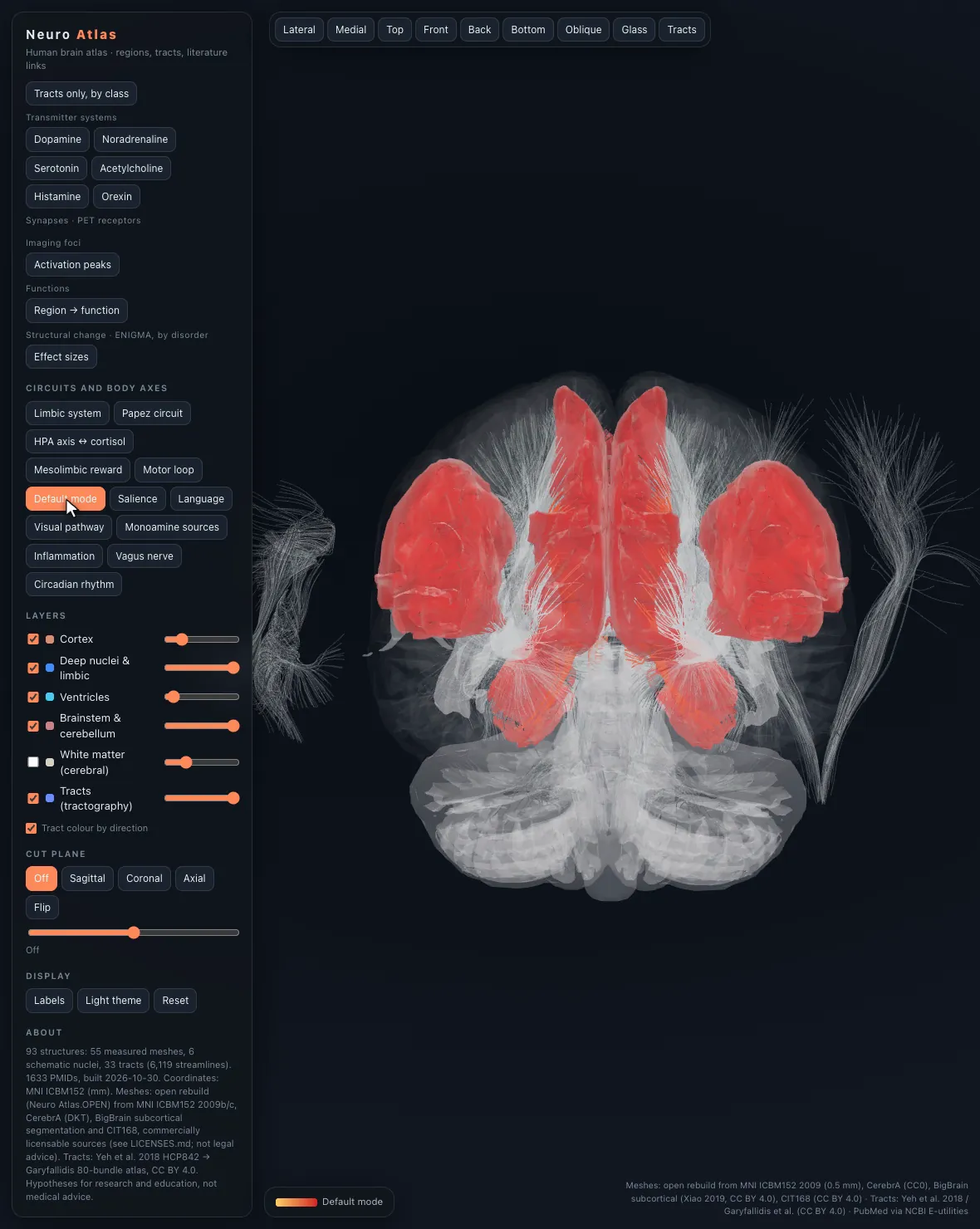 Neuro Atlas 3DOne zoomable brain where every region opens its evidence.3D atlas
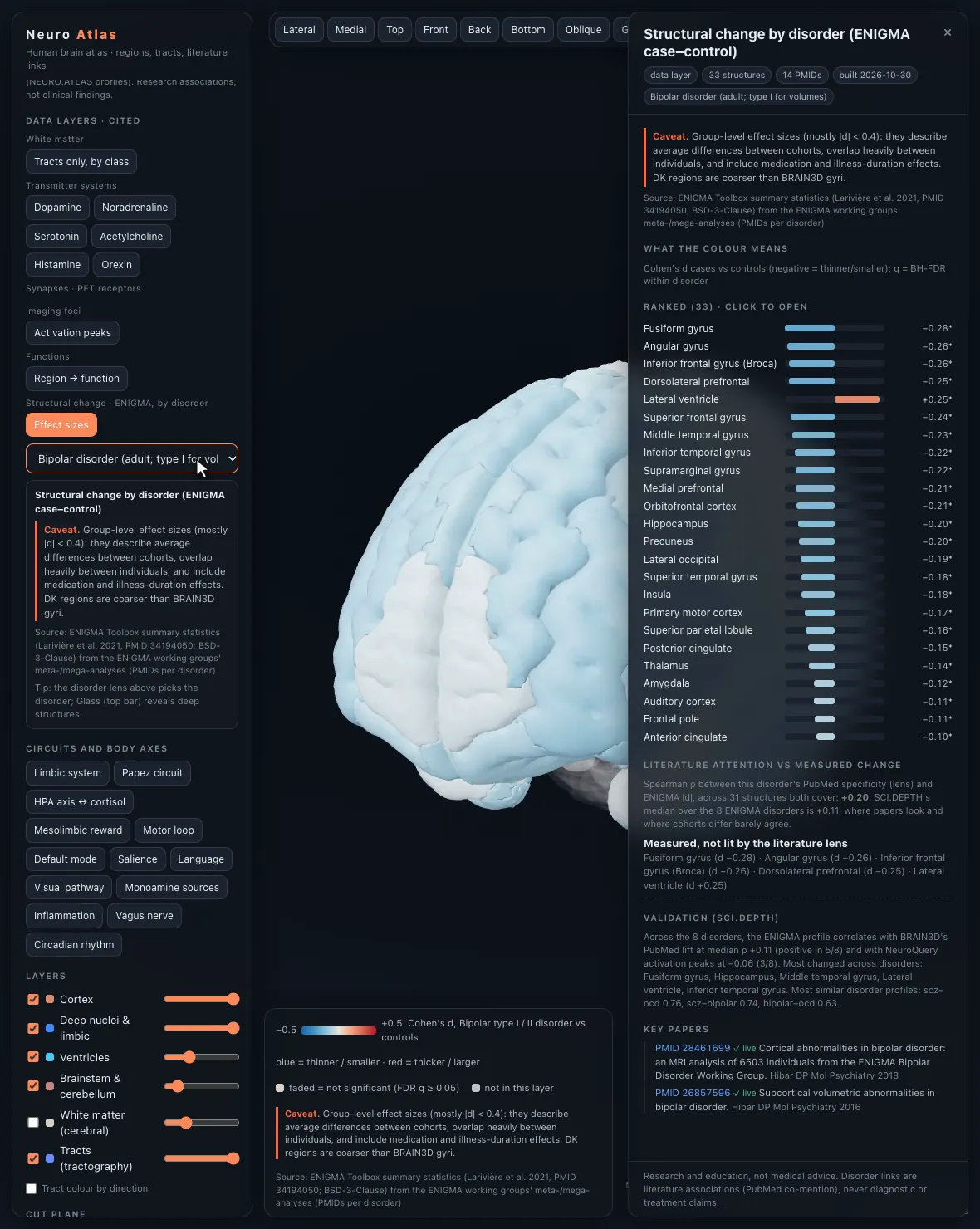
Which disorders a region's literature singles out, what large imaging consortia actually measured there, and the papers behind each claim, side by side on the open-licence brain model, so you can see where literature attention and measured change disagree.
Disorder links are literature associations, not diagnostic or causal claims. ENIGMA effects are group-level (mostly |d| < 0.4) and include medication and illness-duration effects. The viewer loads three.js from a CDN, so the brain needs internet on first open.
MethodSpearman correlation per disorder between each structure's literature specificity and its ENIGMA case–control effect size.
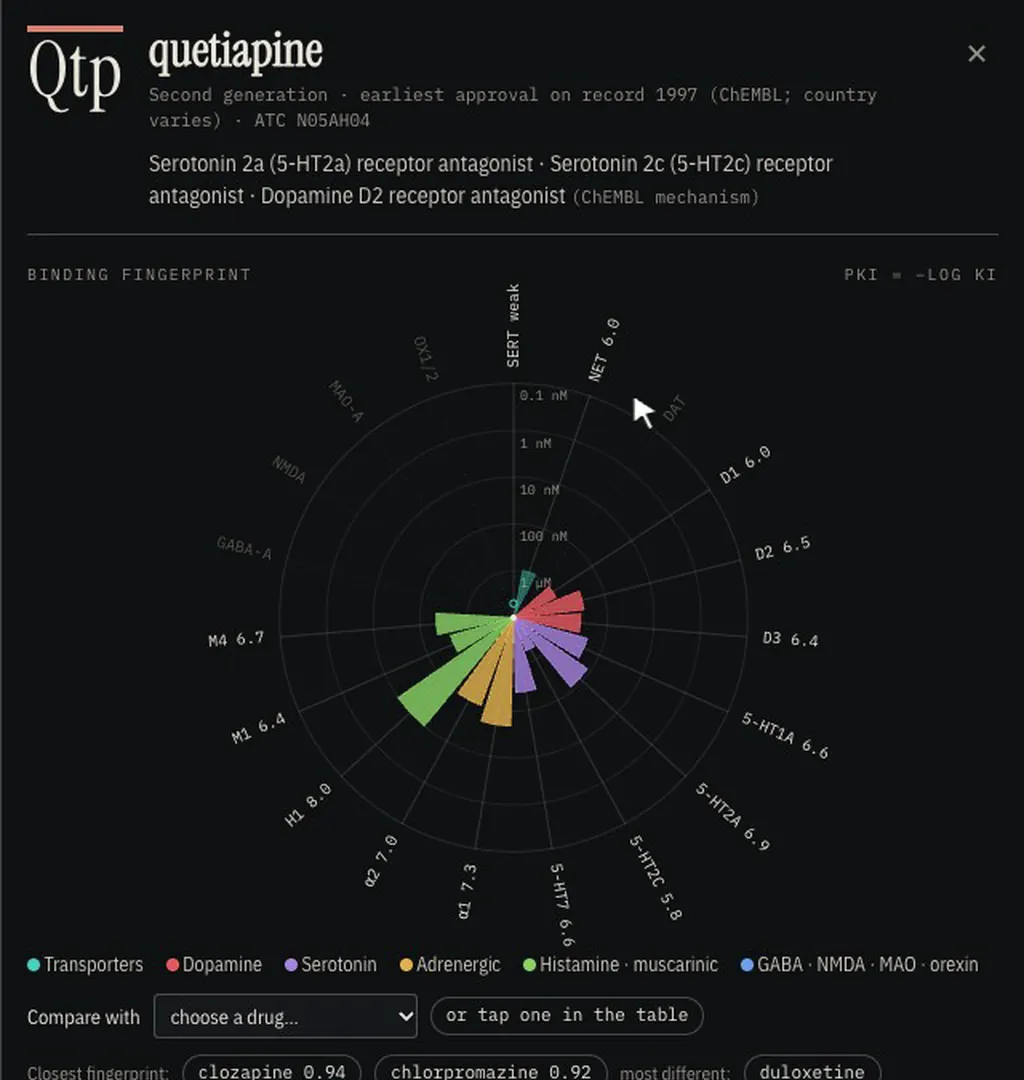 Medicine Cabinet60 psychiatric drugs as binding fingerprints across 19 targets.Receptor fingerprints
Compare receptor profiles at a glance, overlay two drugs, rank the closest relatives by shape, and follow each value to its paper. The commercial version ships without the 3D brain and PET panel.
Binding affinity is not clinical effect: dose, brain exposure, metabolites, occupancy and agonist vs antagonist action are not shown. A missing petal means not in sources, not 'does not bind'. Educational only; no dosing or treatment advice.
MethodPetal length = (pKi − 5) / 5; similarity = cosine of 19-target vectors for pairs with ≥ 4 shared measured targets.
The same sourcing standard, applied to what your team needs.
Evidence briefs, target dossiers and literature maps built around your question, with every figure linked to its source record.
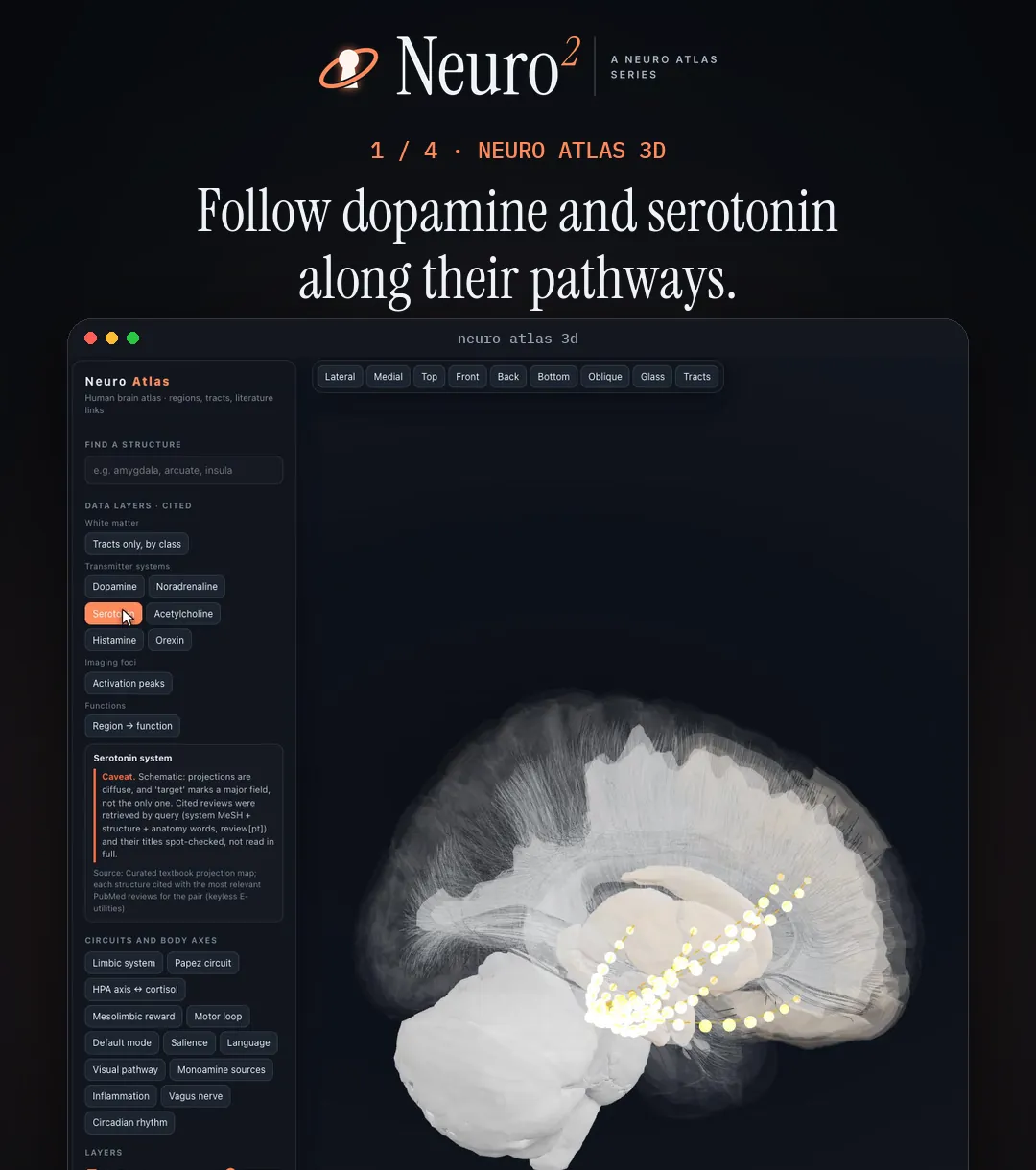
Short explainer films of a mechanism, a dataset or a finding, in the calm Neuro Atlas style, with sources on screen.
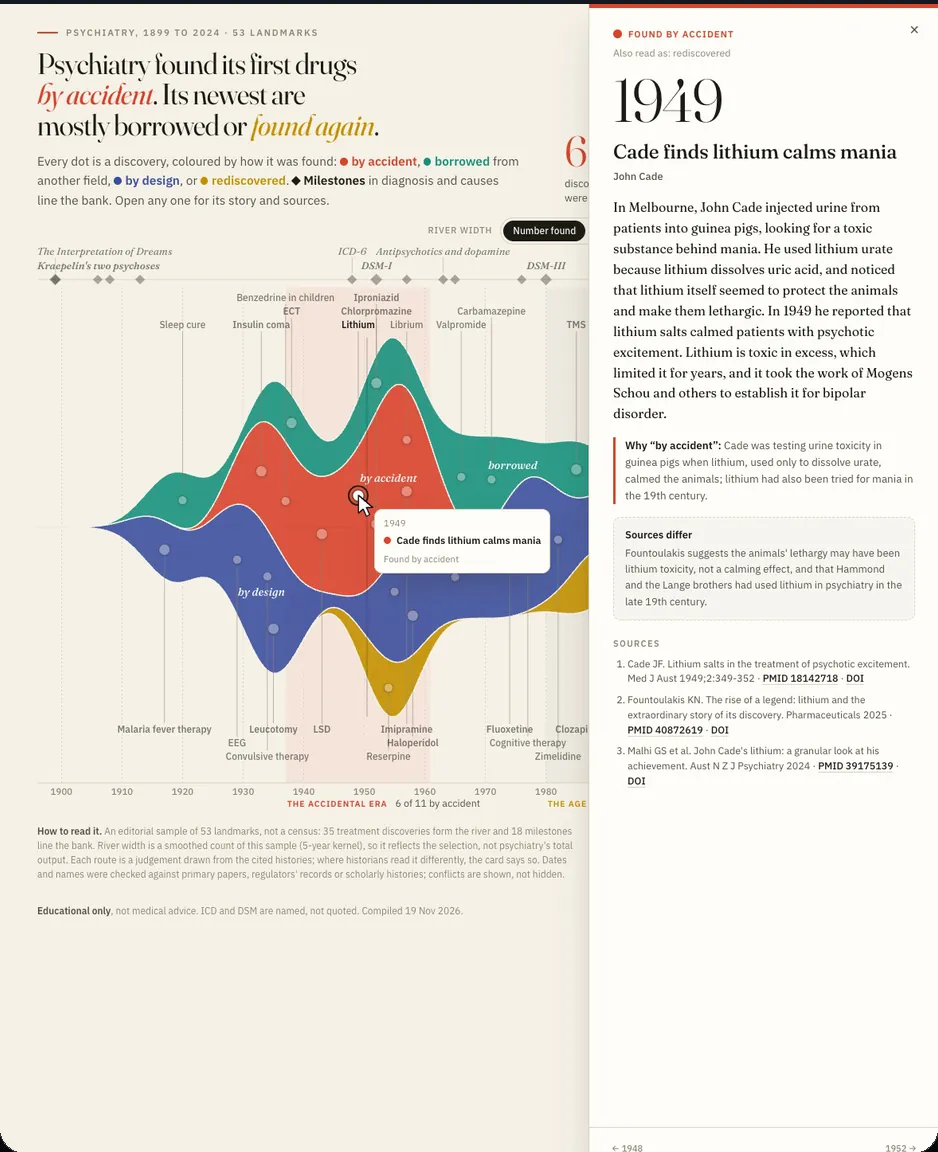
A private browser-based tool over public data or your own, built to the standard of the tools above.
Loops recorded from the tools themselves, cropped to the working area.
| Who it's for | Clinicians, psychiatry and neuroscience research teams, repurposing scouts, licensing and BD analysts, medical educators. |
|---|---|
| How it's delivered | Hosted for your team or packaged as a private build, depending on the tool and your setup. |
| Pricing | Tailored to the tools, seats and any bespoke work you need. Tell us below and we reply with a written quote. |
| Patient data | None. The tools run on public research data; please don't send any patient information. |
Every tool was measured before its number appears here, and each number keeps its caveat beside it. Rankings are not guarantees; co-mention links are leads, not findings. Live forecast lists and predicted links are shared with clients, not shown publicly.
We reply with what we can do, how it would be delivered and a written quote.
No. These are research and education tools. They are not for diagnosis or treatment decisions.
No. The tools run on public research data. If bespoke work would use your own data, we agree how first, and we never need patient information.
By which tools, how many people, how it's delivered and any bespoke work. You get a written quote; nothing is charged without your agreement.
Neuro Atlas, a small independent lab building research tools from public datasets and published studies. Sold by Neuro Atlas, United Kingdom.
An enquiry is just a conversation. You get a written quote, and nothing is charged without your agreement.